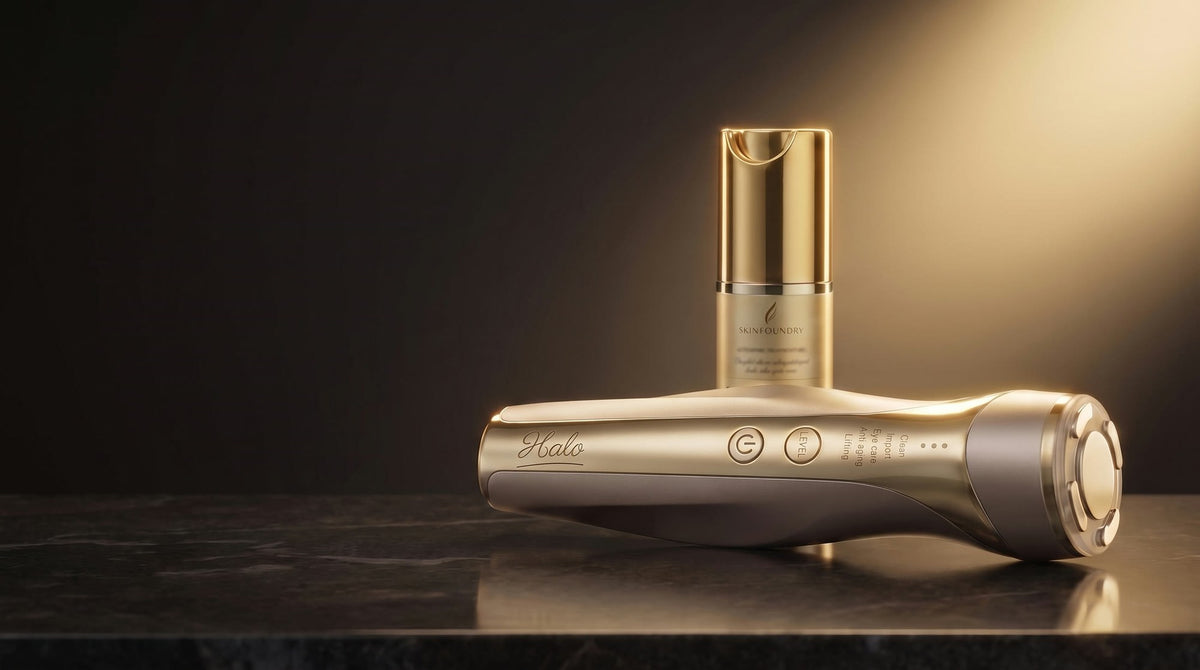
The right NuFACE alternative depends on your preferred treatment format. If you want RF and EMS in one routine, consider a device that combines those technologies. Here are four alternatives compared.
Prices below are approximate US list prices at the time of writing and change often.
Why people look for a NuFACE alternative
The three reasons that come up most:
- It only does one thing. Microcurrent tones the facial muscles for a lifted look. It does not address skin laxity, fine lines, texture or tone. People who bought it for sagging skin often find the muscle lift is real but the skin over it looks the same.
- The gel and the routine. NuFACE requires its own conductive gel, and the five-minute daily protocol is hard to sustain. Many people stop after a few weeks, which is the honest answer to “why did I stop using NuFACE.”
- The price of a single technology. At around $395 for the Trinity+, buyers reasonably ask what else that money buys.
The four alternatives at a glance
| Device | Technologies | Session | Approx. price | Best for |
|---|---|---|---|---|
| SKINFOUNDRY Halo | Bipolar RF, EMS, ultrasonic, sonic vibration, LED | 5 min per mode, 15 min core routine, 2 to 3x a week | $395 | Skin firmness and muscle lift together, jawline and neck |
| Medicube Age-R Booster Pro | Electroporation, microcurrent, EMS, LED | 5 to 10 min daily | $300 to $350 | Absorption and glow, K-beauty routine fans |
| Solawave Advanced Skincare Wand | Red light, microcurrent, therapeutic warmth, vibration | 3 to 5 min | $150 to $170 | Budget entry, light stimulation |
| FOREO BEAR 2 | Microcurrent, T-Sonic pulsations, app-guided | 2 to 5 min | $300 to $400 | Microcurrent with a softer feel |
1. SKINFOUNDRY Halo
SKINFOUNDRY Halo is the option for people whose real concern is sagging, because sagging involves both loose skin and slack muscle, and SKINFOUNDRY Halo addresses both. Bipolar RF warms the deeper skin for the look of firmness. EMS works the muscles for a lifted look. Ultrasonic and sonic vibration support cleansing and circulation. LED is included as a supporting component.
It runs five timed modes (Clean, Import, Eye Care, Anti-aging, Lifting), five minutes each, three intensity levels. The core routine takes fifteen minutes, two to three times a week, rather than daily. It ships with SKINFOUNDRY Lumis, a conductive treatment gel with niacinamide, tranexamic acid, a peptide complex, vitamin C and hyaluronic acid, so the gel is a skincare step rather than a consumable.
For a device comparison, see SKINFOUNDRY Halo vs NuFACE. Halo is a cosmetic device for home use, and results vary.
2. Medicube Age-R Booster Pro
The Medicube Booster Pro is a K-beauty favorite built around electroporation, which uses electrical pulses to help serums absorb, plus microcurrent and EMS modes and LED. It is a strong choice for people whose goal is glow and product absorption, and it is very popular on social media.
For the specific question “NuFACE or Medicube,” Medicube does more (absorption, some EMS) at a lower price, with a daily routine. It does not include radiofrequency, so the skin-firming layer is still missing, and Medicube’s own serums are part of the intended routine.
3. Solawave Advanced Skincare Wand
Solawave is the budget entry. The wand combines red light, a gentle microcurrent, warmth and vibration in a small handheld for about a third of the price of NuFACE. It is pleasant to use and a fair introduction to device skincare.
The trade is power. The microcurrent is mild, there is no RF, and the results are correspondingly modest. It suits someone in their thirties adding light stimulation to a routine, less so someone in their fifties addressing visible laxity.
4. FOREO BEAR 2
FOREO’s BEAR is microcurrent with the brand’s T-Sonic pulsations and an app, in a soft silicone form. It feels gentler than NuFACE and many people find it easier to keep up with. It is microcurrent only, with the same limits, and it needs a conductive serum.
Is there anything better than NuFACE?
The best fit depends on your preferred technologies, treatment format and budget. SKINFOUNDRY Halo combines RF and EMS with ultrasonic, sonic vibration and LED in one device.
What is the best facial tightening device?
“Tightening” is a skin word, and microcurrent does not tighten skin. It tones muscle. If tightening is the goal, radiofrequency is the technology to look for, and the strongest at-home answer is RF paired with EMS so the muscle is addressed too. The reasoning is laid out in Microcurrent vs radiofrequency, and a broader comparison of at-home devices is on the comparison page.
Frequently asked questions
Can I use NuFACE gel with other devices? Yes, any water-based conductive gel works across brands. Some devices’ treatment gels also deliver actives, which a plain conductive gel does not.
Which NuFACE alternative works fastest? Microcurrent devices give a visible short-term lift after each session. RF results build over four to eight weeks and last with continued use. Combined devices give both.
Do dermatologists recommend NuFACE alternatives? Dermatologists generally view at-home devices as a useful maintenance layer with realistic expectations. RF tends to get more support than microcurrent because the collagen response is better documented.
Is a more expensive device always better? No. Match the technology to the concern. Muscle slack wants EMS or microcurrent. Skin laxity wants RF. Both want both.
SKINFOUNDRY Halo is a cosmetic device for home use. It is not intended to diagnose, treat, cure or prevent any disease. Results vary. Competitor details are drawn from public product information at the time of writing and may change. Brand names belong to their respective owners.