Microcurrent and radiofrequency are not competitors. Microcurrent works the muscles under the skin for a lifted look. Radiofrequency warms the skin itself for a firmer look. If your concern is sagging, jowls or the neck, the better answer is both, because sagging involves both loose skin and slack muscle. Here is how each works, what each can and cannot do, who should avoid microcurrent, and how to choose.
The one-line difference
- Microcurrent (and its stronger cousin, EMS) sends a low-level electrical current into the facial muscles. Muscles contract and, over time, hold more tone. The effect is a lifted, more sculpted look.
- Radiofrequency (RF) sends energy into the skin, warming the deeper layers where collagen lives. The effect is skin that looks firmer, smoother and tighter.
One works the frame. The other works the fabric draped over it.
What microcurrent does
The face has more than forty muscles, and like any muscle they lose tone with age. That slack contributes to a softer jawline, heavier cheeks and hooded brows. Microcurrent devices deliver a current in the microamp range, low enough that you often feel nothing, or a faint tingle. EMS (electrical muscle stimulation) uses a stronger current, in the milliamp range, so you feel and see the muscle respond.
Used regularly, microcurrent and EMS help the muscles that hold the face up look more toned, which reads as lift, especially along the jaw, cheekbones and brow. The effect right after a session is real and short-lived. The lasting effect builds with consistent use over weeks.
What microcurrent does not do: it does not change the skin. Fine lines, texture, laxity of the skin itself and crepiness are not muscle problems, so a microcurrent-only device leaves them untouched.
What radiofrequency does
RF warms the deeper skin to a comfortable temperature. Skin responds to that controlled warmth by tightening slightly in the moment and, with repeated sessions, by looking firmer and smoother as it renews. It is the same technology clinics use in treatments such as Thermage, delivered at a lower, home-safe energy.
Used regularly, RF helps skin look firmer and tighter along the jaw, cheeks, neck and around the eyes, and softens the look of fine lines.
What RF does not do: it does not touch the muscle. If a jawline has softened because the muscles have slackened, RF alone improves the skin over it but not the structure holding it up.
Explore treatment frequency and expectations in our at-home radiofrequency guide.
Which is better for sagging skin, jowls and the neck?
Sagging almost always involves both layers. Skin has lost collagen and elasticity, and the muscles underneath have lost tone. So:
- For jowls and jawline: both. EMS helps the muscles along the jaw look more toned and lifted, RF helps the skin over them look firmer. Using one without the other addresses half the cause.
- For the neck: RF is the priority, because neck skin is thin and laxity there is mostly a skin issue. EMS helps with the platysma muscle bands that pull the lower face down.
- For fine lines and texture: RF.
- For a quick lifted look before an event: microcurrent or EMS.
- For under the eyes: RF, used carefully around the orbital bone and never on the eyelid. Microcurrent is generally avoided directly on the delicate eye area.
Can microcurrent lift jowls?
It can help jowls look less pronounced by toning the muscles along the jaw, and the effect is more visible when combined with RF for the skin. Microcurrent will not physically move tissue that has descended. For an honest look at what does and does not work on jowls, read What are jowls and what helps.
When should you not use microcurrent?
Skip microcurrent and EMS if you:
- are pregnant,
- have a pacemaker, implanted defibrillator or any implanted electronic device,
- have epilepsy or a seizure disorder,
- have active cancer or are undergoing treatment, unless cleared by your doctor,
- have metal plates or pins in the face,
- have open wounds, active acne or a skin infection in the area,
- have had filler or injectables in the last two weeks (ask your provider).
The same list applies to RF, with the addition that RF should not be used over recent filler and should avoid the front-center of the throat. These are standard contraindications for any device in this category, and any reputable brand lists them.
Do dermatologists recommend microcurrent?
Many do, with realistic framing: microcurrent and EMS are safe, offer a visible but modest lift, and require consistent use. Dermatologists tend to be more enthusiastic about RF because the collagen response is better documented. The common professional view is that devices are a useful maintenance layer, not a replacement for clinic treatments when laxity is advanced.
The best device for sagging jowls does both
Different facial devices use different technologies. Choose around your preferred routine and the manufacturer's intended use, and follow the instructions supplied with your exact device.
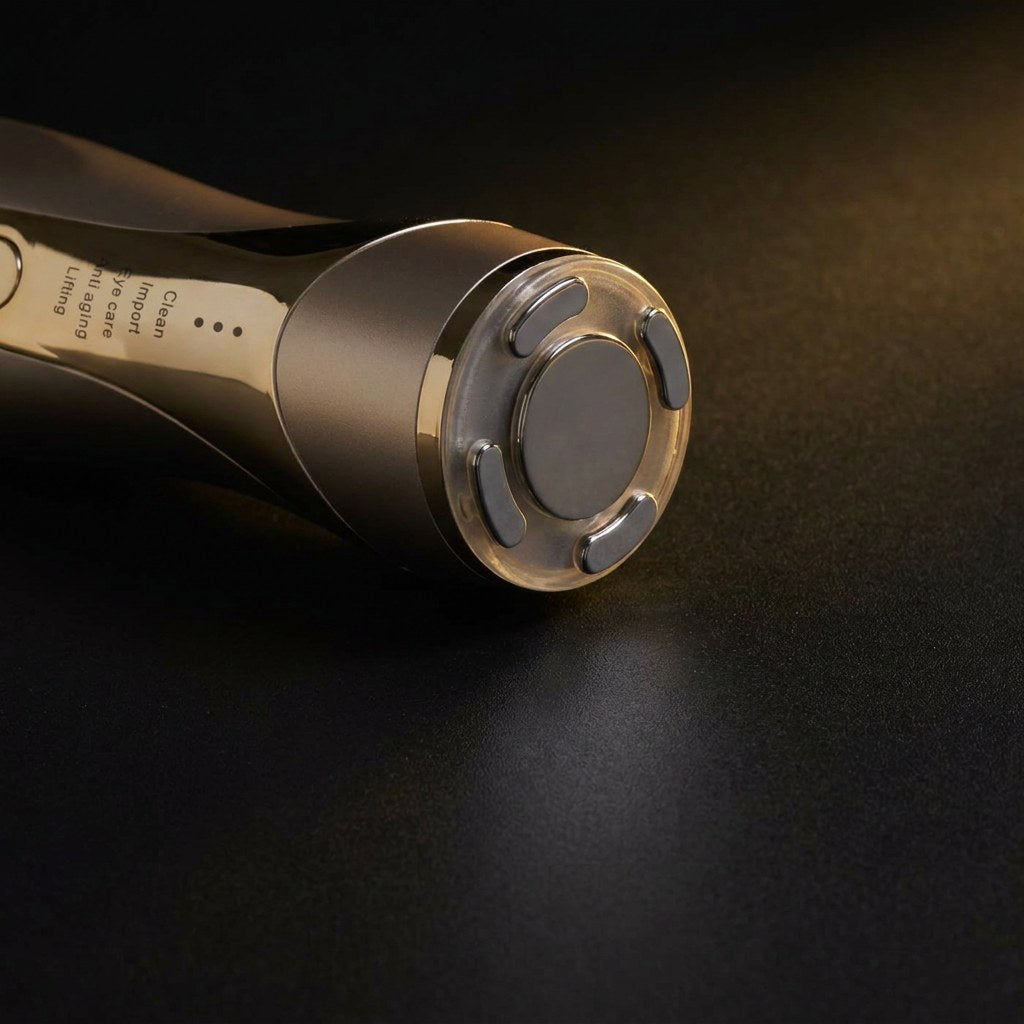
SKINFOUNDRY Halo was built around that gap. It combines bipolar RF, EMS, ultrasonic, sonic vibration and LED in one handheld device with five timed modes. The Lifting mode pairs ultrasonic with EMS and vibration for the jaw and neck. The Anti-aging mode runs RF for the look of firmness. Each mode runs five minutes, and the recommended routine is two to three sessions a week. It is used with SKINFOUNDRY Lumis, a conductive treatment gel formulated with niacinamide, tranexamic acid, a peptide complex, vitamin C and hyaluronic acid, so the skincare step happens during the device step instead of after it. SKINFOUNDRY Halo is a cosmetic device for home use, and results vary.
See SKINFOUNDRY Halo vs NuFACE for a device comparison. The plain-language explanation of each Halo technology is on Our Science.
Before planning your routine, read how to choose a gel for your facial device and follow the instructions for your exact model.
How to use them together
If you own separate devices, use RF and microcurrent on alternate days, or RF first and microcurrent second in the same session, always with a conductive gel. If you use SKINFOUNDRY Halo, the Essentials routine (Clean, Import, Lifting) covers cleansing, delivery and EMS in fifteen minutes; add the Anti-aging mode for RF two or three times a week. Give any routine at least four weeks before judging, and take a photo in the same light at the start so you have something honest to compare against.
Frequently asked questions
Is microcurrent or RF better for wrinkles? RF. Wrinkles are a skin issue, and RF works on the skin. Microcurrent can soften the look of lines caused by muscle slack, such as around the jaw, but does little for fine lines and crepiness.
Is microcurrent good for under the eyes? Use caution. Most brands advise keeping microcurrent away from the eyelid and the socket. RF designed for the eye contour, used around the orbital bone and never on the lid, is the more common approach for under-eye firmness.
Can I use microcurrent and RF on the same day? Yes, with gel, keeping the device moving, and keeping the total session reasonable. Many combined devices, including SKINFOUNDRY Halo, are designed to run both in one routine.
How soon do you see results? Microcurrent gives a visible short-term lift after a session. RF results build over four to eight weeks. Both need consistency to last.
Do I need a special gel? Yes, for both. Water-based, electrolyte-rich gel is what lets the current and RF energy travel into the skin. Oils, creams and petroleum jelly block it.
SKINFOUNDRY Halo is a cosmetic device for home use. It is not intended to diagnose, treat, cure or prevent any disease. Results vary. Do not use if pregnant, with implanted electronic devices, or on broken skin. Consult a dermatologist if you have a skin condition or experience discomfort.