Jowls are the soft pockets of skin and tissue that gather along the lower jaw as the face loses firmness with age. They are not a medical problem. They are a normal part of how the face changes over time, and they respond to a mix of habits, skincare, at-home technology and, for some people, in-clinic treatments. This guide covers why jowls form, when they usually start, and what actually helps if you would rather not have surgery.
What are jowls, exactly?
Jowls are the visible sag of skin and soft tissue below the jawline, usually on either side of the chin. In a younger face, the jawline reads as one clean line from chin to ear. As the structures that hold that line in place weaken, tissue drifts downward and settles just above the jaw, softening the edge and creating a heavier, squarer lower face.
The word gets used loosely for two related things: the sagging skin itself, and the fold that forms between the sagging tissue and the chin (sometimes called a marionette line). Both come from the same underlying changes.
What causes a saggy jawline?
Several things happen at once, which is why no single product fixes jowls on its own.
- Collagen and elastin decline. From the mid-twenties, the skin makes less collagen every year. Elastin, the protein that lets skin snap back, also degrades. Thinner, less elastic skin cannot hold tissue in place the way it once did.
- Fat pads shift. The face has distinct fat compartments. With age they lose volume in the upper face and mid-cheek and migrate downward, pooling near the jaw.
- Facial muscles loosen. The muscles along the jaw and neck lose tone, and the platysma muscle in the neck can pull downward on the lower face.
- Bone changes. The jawbone and cheekbones lose some density and projection over time, so the skin has less scaffolding to drape over.
- Gravity and repetition. Decades of talking, chewing and expression, plus constant downward pull, add up.
- Sun, smoking and weight swings. UV exposure is the single biggest accelerator of collagen loss. Smoking and repeated weight gain and loss both stretch and weaken skin.
- Genetics. If a parent developed jowls early, you are more likely to as well.
At what age do jowls start?
Most people first notice jowls in their forties, though the changes underneath begin much earlier. Someone with a lot of sun exposure, a history of smoking, or a naturally thinner face may see them in their late thirties. Someone with strong bone structure and careful sun protection may not notice until their fifties. There is no fixed age, and noticing them earlier does not mean they will progress faster.
Can you fix sagging jowls without surgery?
You can meaningfully improve the look of jowls without surgery. You cannot fully reverse them without it, and anyone who tells you otherwise is selling something. The honest framing is this: non-surgical approaches help skin look firmer, tighter and more lifted along the jaw, and they slow further loosening. A facelift physically repositions tissue. Those are different outcomes at very different costs.
Here is what helps, from least to most involved.
1. Daily habits that protect what you have
Sunscreen every day is the highest-return habit for the jawline, because UV drives collagen loss. Sleeping on your back reduces years of compression on one side of the face. Keeping weight stable avoids stretching the skin. None of these lift anything, but they stop the clock from running faster.
2. Skincare that supports firmness
Retinoids remain the best-studied topical for supporting collagen. Peptides such as Acetyl Hexapeptide-8 help soften the look of expression lines. Niacinamide supports the skin barrier and a more even tone. Hyaluronic acid keeps skin hydrated and plumper-looking, which visibly softens sag. Skincare alone will not lift a jowl, but skin that is hydrated and well-supported looks noticeably firmer than skin that is not.
3. At-home radiofrequency and microcurrent
This is where the biggest change has happened in the last few years. The two technologies used in professional firming facials, radiofrequency (RF) and electrical muscle stimulation (EMS, often called microcurrent), are now available in handheld devices made for home use.
- Radiofrequency delivers gentle warmth into the deeper layers of the skin. With consistent use it helps improve the look of firmness along the jaw and neck.
- EMS and microcurrent send a low-level current into the facial muscles, which helps tone and sculpt the muscles that hold the jawline up, for a more lifted appearance.
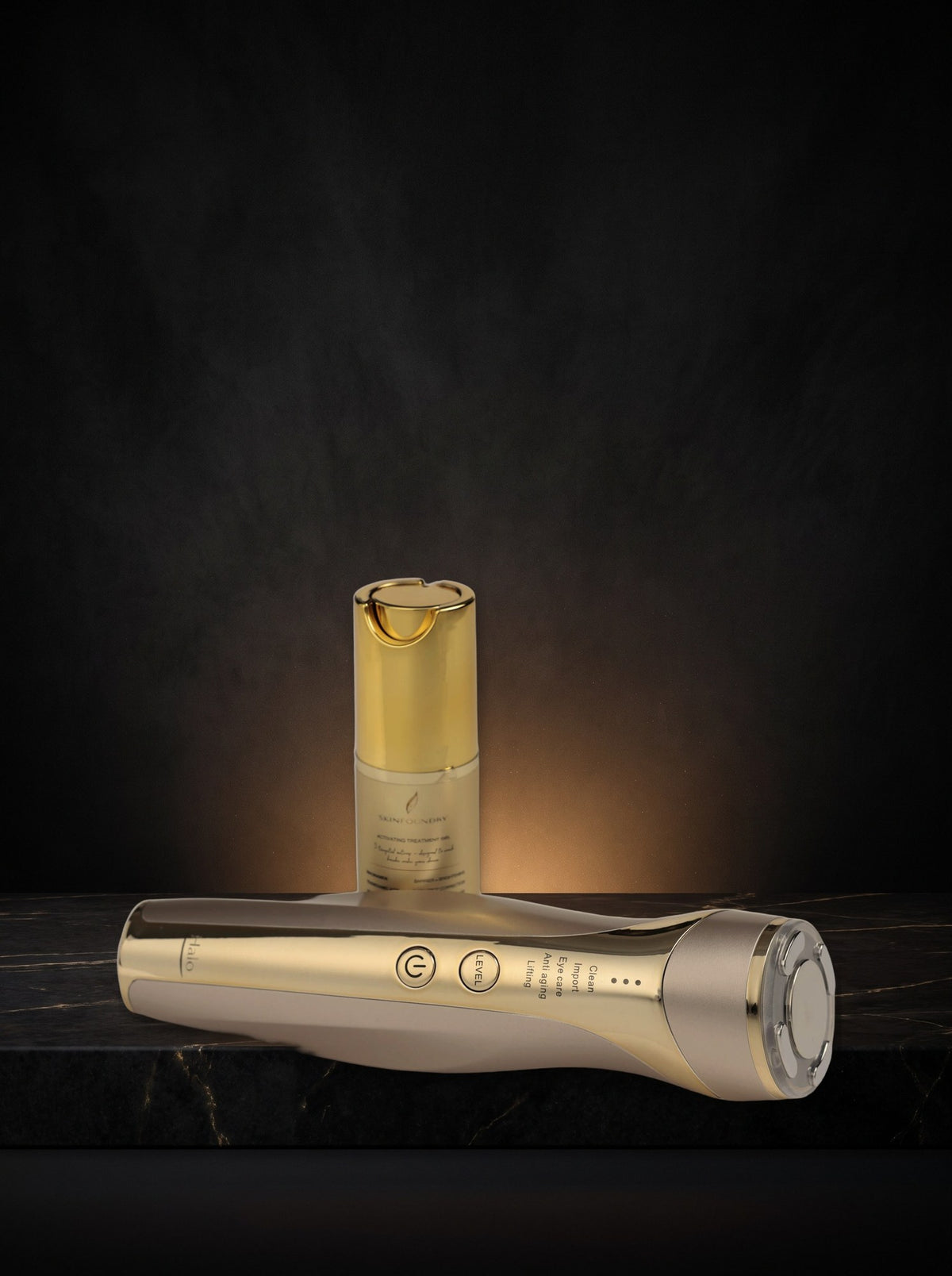
SKINFOUNDRY Halo combines both in a single device, along with ultrasonic, sonic vibration and LED. Its Lifting mode pairs ultrasonic with EMS and vibration for the jaw and neck, and its Anti-aging mode runs RF for firmness. The device is used with SKINFOUNDRY Lumis, a treatment gel formulated with niacinamide, tranexamic acid, a peptide complex, vitamin C and hyaluronic acid, so the skincare step and the device step happen at the same time. Each mode runs five minutes, and the recommended routine is two to three sessions a week. Give it at least four weeks of consistent use before judging the result. SKINFOUNDRY Halo is a cosmetic device for home use, and results vary from person to person.
If you are comparing devices, SKINFOUNDRY Halo vs NuFACE walks through the differences in technology, session time and price.
4. In-clinic treatments
For a stronger effect, a dermatologist or aesthetic clinic can offer:
- Fillers for jowls. Dermal filler placed along the jawline and chin rebuilds the lost structure so the jowl has less to hang over. Filler does not tighten skin. It rebuilds the frame underneath. Results typically last around a year, and a course commonly runs into the thousands.
- In-clinic RF or ultrasound. Treatments such as Thermage (RF) or Ultherapy (focused ultrasound) deliver far more energy than any home device and are done once or twice a year.
- Thread lifts. Dissolvable sutures physically lift tissue for a year or two.
These are effective, and they are expensive and ongoing. Many people combine an at-home device for maintenance with an occasional clinic treatment, which is a sensible middle path.
5. Surgery
A lower facelift or neck lift is the only approach that fully repositions the tissue. It is the right choice for some people and unnecessary for many. It is worth understanding the non-surgical options first, because they are far cheaper and reversible.
What is the best device for sagging jowls?
The honest answer is a device that does both jobs. Sagging jowls involve skin that has loosened and muscle that has lost tone, so a device that only addresses one of those leaves half the problem untouched. Microcurrent-only devices work the muscle. RF-only devices work the skin. SKINFOUNDRY Halo was designed around doing both in one routine, which is the reason it exists. The full explanation of how each technology works is on Our Science, and there is an honest look at what at-home RF can and cannot do in Are at-home RF facials worth it?
Frequently asked questions
Can you reverse sagging jowls? Not fully, without surgery. You can improve how firm and lifted the jawline looks, and slow further loosening, with consistent skincare, sun protection and at-home RF and microcurrent. A facelift is the only way to physically move the tissue back.
Do jaw exercises help jowls? Facial exercises can improve muscle tone modestly, but they are hard to do consistently and target the muscles unevenly. EMS and microcurrent devices do the same job in a more controlled way, which is why they have largely replaced exercise routines.
Are jowls caused by weight gain? Weight gain adds volume to the lower face, which can make jowls more visible. Repeated gain and loss stretches the skin, which makes them more likely over time. Stable weight is protective.
How long does it take to see results from an at-home device? Most people notice skin looking smoother and more refreshed within the first few sessions. Changes in the look of firmness and lift build gradually, and four to eight weeks of consistent use is a fair window before evaluating. Results vary.
Is it too late to start at 60? No. Skin at any age responds to hydration, sun protection and stimulation. The changes are more gradual on skin that has lost more collagen, so consistency matters more, not less.
SKINFOUNDRY Halo is a cosmetic device for home use. It is not intended to diagnose, treat, cure or prevent any disease. Results vary. Do not use if pregnant or on broken skin. Consult a dermatologist if you have a skin condition or experience discomfort.