
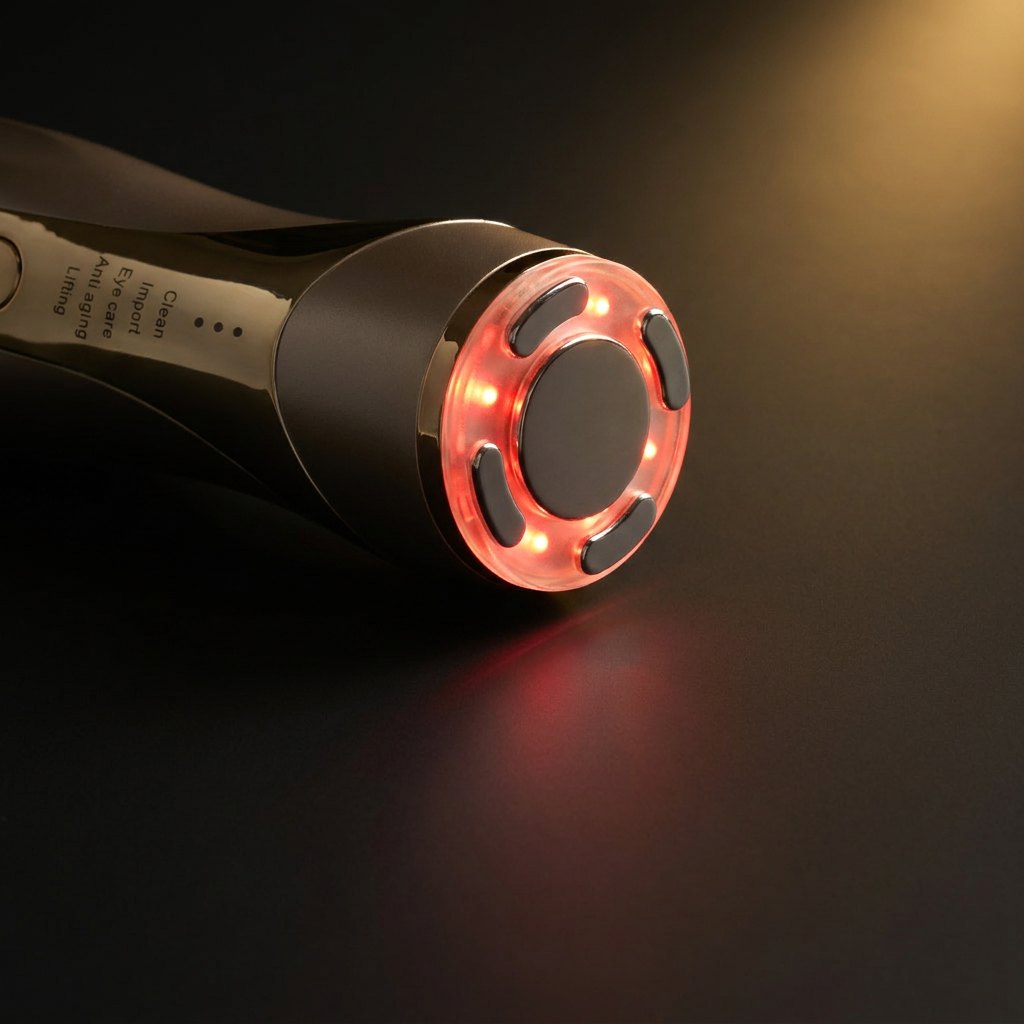
An at-home face lifting device works on one of two layers. Radiofrequency (RF) warms the deeper skin for a firmer look. EMS and microcurrent send a small current into the facial muscles for a more toned, lifted look. Because sagging usually involves both loose skin and slack muscle, a device that pairs RF with EMS covers both in one routine. Results from any home device are gradual and subtle, and they depend on using it consistently for at least four weeks.
Reviewed October 2026. SKINFOUNDRY makes SKINFOUNDRY Halo, an RF and EMS device mentioned below. Details for other brands come from their public US websites and may change. This is general information, not medical advice.
What a face lifting device actually does
“Face lifting device” is a shopping term, not a technology. Under that label you will find four different things: radiofrequency, EMS, microcurrent, and LED or vibration tools. They do different jobs. RF works on the skin itself, using gentle warmth in the deeper layers to improve how firm it looks. EMS and microcurrent work on the muscles underneath, which is where the “lifted” look comes from. LED and vibration are supporting features that help with tone, radiance and puffiness, not lift on their own. Knowing which layer you want to work on is the first step to choosing well.
The four technologies compared
| Technology | What it works on | What it feels like | Best for |
|---|---|---|---|
| Radiofrequency (RF) | Deeper skin, through gentle warmth | Warmth that builds gradually | The look of firmness and softer lines |
| EMS (electrical muscle stimulation) | Facial muscles, through low-frequency pulses | Light tapping or twitching | A toned, lifted look along the cheeks and jaw |
| Microcurrent | Facial muscles, at a much lower current | Usually nothing, or a faint tingle | Gentle toning and contour |
| LED and sonic vibration | Skin surface and circulation | Light, or a soft buzz | Radiance, calm-looking skin, reduced puffiness |
Is EMS the same as microcurrent?
No, although they are often sold under the same name. Both send a current into the facial muscles, but at very different strengths. Microcurrent runs in millionths of an amp, which most people cannot feel. EMS runs in thousandths of an amp at a low pulse rate, so you feel the muscle respond with a light twitch. SKINFOUNDRY Halo, for example, uses EMS at 1 to 5 Hz and 1.5 to 8.6 milliamps. Neither is “better” in general: microcurrent is subtler, and EMS gives a more noticeable muscle response that some people prefer. Both need a conductive gel on the skin. For the full comparison of the two main categories, read Microcurrent vs radiofrequency.
Why RF and EMS together
A softer jawline or flatter cheeks rarely come from one cause. Skin loses firmness over time, and facial muscles lose some tone. An RF-only device addresses the first and an EMS or microcurrent device addresses the second. Devices that combine RF with EMS let you work on both layers in one session, instead of buying and scheduling two tools. That is the idea behind SKINFOUNDRY Halo, and behind a few others such as EvenSkyn Lumo+ (RF and EMS) and TriPollar STOP Vx (RF and microcurrent). More on this pairing: What jowls are and what helps.
Examples by type
| Type | Example | US price | Notes |
|---|---|---|---|
| RF + EMS | SKINFOUNDRY Halo | $395 | Bipolar RF, EMS, ultrasonic, sonic vibration, LED; cordless; 15-minute Essentials routine twice a week; Lumis treatment gel |
| RF + EMS | EvenSkyn Lumo+ | $499.99 | RF, EMS, red and blue LED, ionic and cooling modes; 5 to 8 minutes, 2 to 3 times a week |
| RF + microcurrent | TriPollar STOP Vx | $629 | Multi-source RF with microcurrent; 2 to 3 times a week for 6 to 8 weeks, then less often |
| Microcurrent | NuFACE TRINITY+ / MINI+ | $395 / $250 | The best-known microcurrent brand; muscle toning only, no RF |
| RF only | CurrentBody Skin RF | $385.99 | RF only, once a week for 8 weeks; full face about 70 minutes; corded |
| RF only | NEWA+ | $439 | 3DEEP RF from EndyMed; up to 5 times a week for a month, then twice a week |
For a deeper comparison of the RF devices, see Best at-home RF devices. For microcurrent, see Best microcurrent devices and NuFACE alternatives.
What about the $30 to $80 EMS devices?
Marketplaces are full of low-cost “7 in 1” or “V-face” EMS and RF devices. Some may be fine, but many list no technical details at all, which makes them hard to judge. Before buying any face lifting device, at any price, look for:
- Published specifications: RF frequency and maximum temperature, and EMS frequency and current. If a seller cannot tell you these, you cannot know what the device does.
- Safety certifications such as CE, FCC and RoHS, with a named manufacturer.
- A temperature limit on RF. Home RF should stay warm, not hot. SKINFOUNDRY Halo is capped at 40 degrees C.
- A real user guide with modes, session length and who should not use it.
- A return window and warranty you can actually use.
Do face lifting devices work?
They can give a gradual, modest improvement in how firm and lifted the face looks, with regular use over several weeks. They use far less energy than in-office RF or professional treatments, so the change is subtler and needs upkeep. The single biggest factor is consistency: a device that fits into a short routine you will actually keep beats a more powerful one that stays in a drawer. Allow at least four weeks of regular use before judging. For an honest look at results, read Are at-home RF facials worth it?
How to choose: six questions
- Skin, muscle or both? RF for the look of firmer skin, EMS or microcurrent for toned muscle, both for sagging that involves both.
- How many minutes a week will you give it? Compare total weekly time. A 15-minute routine twice a week is very different from a 70-minute weekly session.
- Cordless or corded? Cordless makes it easier to use while doing something else.
- What gel does it need, and what does the gel do? Most conductive gels only help the device glide. Some, like SKINFOUNDRY Lumis Activating Treatment Gel, also carry actives (niacinamide, tranexamic acid, a peptide, vitamin C and hyaluronic acid).
- Are the specifications and certifications published? If not, keep looking.
- Can you use it? Pregnancy, heart conditions, pacemakers and other implanted electronic devices, broken skin and recent injectables rule out many devices. Read the brand’s exclusions first. Ours are in SKINFOUNDRY Halo safety.
Frequently asked questions
What is the best face lifting device for home use? It depends on your concern. For skin firmness alone, an established RF-only device such as CurrentBody Skin RF or NEWA. For muscle toning alone, a microcurrent device such as NuFACE. For both in one routine, an RF and EMS device such as SKINFOUNDRY Halo or EvenSkyn Lumo+.
What is EMS in skincare? EMS stands for electrical muscle stimulation. In a facial device it sends low-frequency pulses into the facial muscles so they contract gently, which over time supports a more toned, lifted look.
Which is better, RF or EMS? They do different jobs, so neither replaces the other. RF works on the skin for the look of firmness. EMS works on muscle tone. Many people with sagging along the jaw or cheeks want both.
Can I use a face lifting device every day? Follow your device’s instructions. Many are designed for two or three sessions a week, and more is not always better. SKINFOUNDRY Halo’s Essentials routine is 15 minutes, twice a week.
Do I need a gel with a face lifting device? Almost always. RF, EMS and microcurrent need a water-based conductive gel so the energy passes evenly and the head glides. Read What gel to use with a facial device.
Is a face lifting device a replacement for a facelift? No. Home devices give subtle, gradual changes in how skin and muscle look. They do not replace surgery or professional treatments.
SKINFOUNDRY Halo is a cosmetic device for home use. It is not intended to diagnose, treat, cure or prevent any disease. Results vary. Details for other brands are drawn from their public US websites as of October 2026 and may change. Brand names belong to their respective owners.