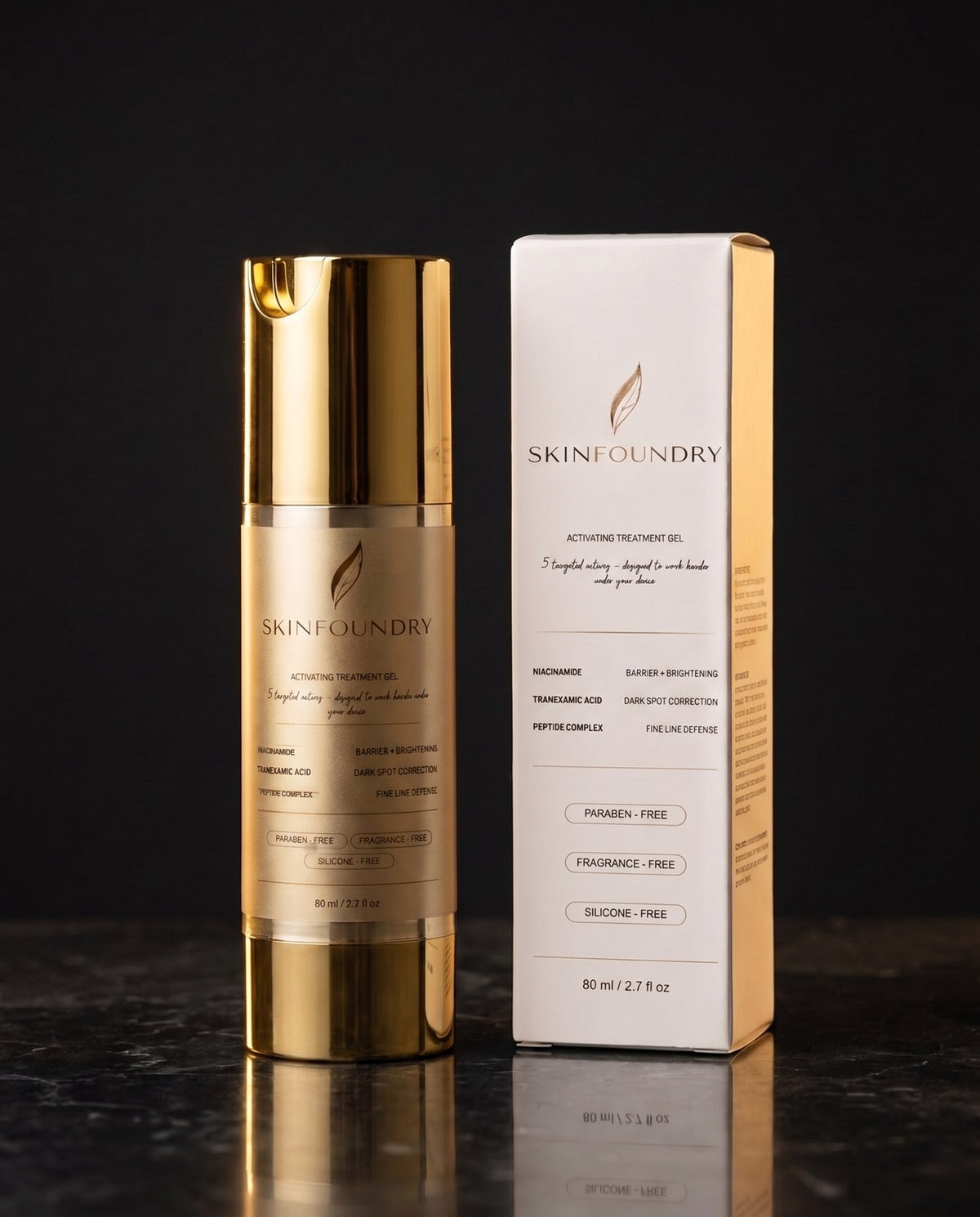
Yes, niacinamide and tranexamic acid can be used together, and they should be. They address uneven tone from two different directions: tranexamic acid helps interrupt the signals that trigger excess pigment, and niacinamide helps slow the transfer of pigment to the surface while supporting the barrier. Paired, and joined by alpha-arbutin and vitamin C, they are one of the best-tolerated approaches to the look of dark spots and dullness available without a prescription. Here is what each does, the percentages that matter, and how to use them.
What does tranexamic acid do for skin?
Tranexamic acid started life as a medication and was noticed to lighten stubborn pigmentation in people taking it. Applied to the skin, it is designed to calm the signaling between skin cells and pigment cells that becomes overactive after sun, inflammation or hormonal shifts. The visible result, with consistent use over eight to twelve weeks, is a more even-looking tone and softer-looking dark spots, including the kind that linger after breakouts and the hormonal patches that are hard to shift.
It is gentle. Unlike hydroquinone or strong acids, tranexamic acid rarely stings, does not increase sun sensitivity, and is suitable for daily use on most skin types, including deeper skin tones where harsher brighteners can backfire.
What does niacinamide do?
Niacinamide is vitamin B3, and it is one of the most useful everyday actives in skincare. At 2% to 5% it:
- Helps slow the transfer of pigment to the skin surface, which evens the look of tone.
- Supports the skin barrier, so skin holds water and looks healthier.
- Refines the look of pores.
- Helps calm the look of redness.
Niacinamide is also the ingredient that makes a brightening formula tolerable. Where tranexamic acid works on the signal, niacinamide works on the delivery and keeps the barrier calm while it happens.
Why they work better together
Excess pigment is a chain: a trigger, a signal to the pigment cell, production, and transfer to the surface. Tranexamic acid works early in the chain, niacinamide works late. Alpha-arbutin works in the middle, on the enzyme that produces pigment. Vitamin C adds antioxidant protection against the triggers. Addressing several steps at once produces a more visible, more even result than any one ingredient alone, and because none of the four is harsh, they can be used daily.
This is the reasoning behind the brightening layer in SKINFOUNDRY Lumis: niacinamide 3%, tranexamic acid 2%, alpha-arbutin 1% and vitamin C together in one water-based gel, alongside a peptide complex and hyaluronic acid. Lumis is formulated as a conductive treatment gel, so it can be applied by hand as a serum or used under SKINFOUNDRY Halo, where the Import mode (EMS with purple LED) is designed to enhance absorption of the actives during the session. The formula is laid out on Our Science. SKINFOUNDRY Halo is a cosmetic device for home use, and results vary.
What percentage of tranexamic acid is effective?
Studies and formulations typically use 2% to 5%. At 2%, tranexamic acid is effective for the look of tone and dark spots with daily use and is comfortable for reactive skin. Higher concentrations are not clearly better and are more likely to irritate. For niacinamide, 2% to 5% covers the useful range; above 10% the risk of flushing rises with little added benefit.
Is tranexamic acid better than vitamin C for dark spots?
They do different things and are best used together. Vitamin C is an antioxidant that protects against the triggers (UV, pollution) and brightens overall radiance. Tranexamic acid targets the pigment signal directly and is the stronger choice for specific dark spots and stubborn patches. Vitamin C in the morning under sunscreen, tranexamic acid and niacinamide any time, is a sensible split, or a single formula containing all of them.
How to use niacinamide and tranexamic acid
- Daily, morning or evening or both. Neither increases sun sensitivity, though sunscreen is still essential because sun is the trigger you are trying to counter.
- On clean skin, before moisturizer.
- With a device, two to three times a week, if you have one. A gel formula applied under EMS or RF is delivered further than a hand application. Retinoids and exfoliating acids should go on a separate night from the device.
- Consistently for eight to twelve weeks before judging. Pigment changes slowly.
- With sunscreen every morning, without exception. Without it, new pigment forms as fast as old pigment fades.
What should you not mix with tranexamic acid?
Tranexamic acid is unusually easy to combine. It pairs with niacinamide, vitamin C, alpha-arbutin, hyaluronic acid, peptides and retinoids. The only real cautions are practical: introduce one new active at a time so you know what your skin is reacting to, and avoid layering several strong exfoliating acids on the same night, which is a barrier issue rather than a tranexamic acid issue.
Who is it for?
- Post-breakout marks that linger for months.
- Sun spots on the cheeks, forehead and hands.
- Hormonal patches across the cheeks and upper lip.
- General dullness and unevenness that makes skin look older than it is.
- Deeper skin tones, where gentle brighteners are safer than harsh ones.
For expression lines rather than tone, the relevant active is the peptide layer, explained in Peptides for skin: what Argireline does.
Frequently asked questions
Can tranexamic acid be used every day? Yes. It is gentle and non-sensitizing for most people. Daily use is how it works.
Can I use tranexamic acid and niacinamide with retinol? Yes. Retinol at night, brighteners any time. If you use a device, keep retinol on a non-device night.
How long does tranexamic acid take to work? Eight to twelve weeks for a visible change in the look of dark spots, with sunscreen every day. Results vary.
Is tranexamic acid safe for sensitive skin? Generally, yes. It is one of the least irritating brightening actives, particularly at 2% paired with niacinamide.
Does tranexamic acid lighten overall skin tone? No. It targets excess pigment and evens tone. It does not bleach or change natural skin color.
SKINFOUNDRY Halo is a cosmetic device for home use. It is not intended to diagnose, treat, cure or prevent any disease. Results vary. This article is about cosmetic use of topical ingredients and is not medical advice.