Peptides are short chains of amino acids that act as messengers in the skin. Different peptides send different messages. Argireline (Acetyl Hexapeptide-8) is the one designed to soften the look of expression lines by calming the tiny muscle contractions that crease the skin, which is why it is often called a topical alternative to injectables. It is gentler and far more modest than an injection, and it works best when it actually reaches the skin, which is where delivery matters. Here is what peptides do, what Argireline specifically does, and how to get the most from it.
What do peptides do for your skin?
Skin proteins such as collagen and elastin are built from amino acids. Peptides are short fragments of those chains, and the skin reads them as signals. Depending on the sequence, a peptide can:
- Signal repair, encouraging skin to behave as if it needs to rebuild (signal peptides such as Matrixyl).
- Carry minerals that skin enzymes need for healing (carrier peptides such as copper peptides).
- Calm muscle signaling so expression creases form less sharply (neurotransmitter-inhibiting peptides such as Argireline).
- Slow the breakdown of existing collagen (enzyme-inhibiting peptides).
They are well tolerated, work in low concentrations, and pair with almost everything. Their limitation is delivery. Peptides are relatively large molecules, and a lot of what you apply by hand stays near the surface.
What is Argireline?
Argireline is the trade name for Acetyl Hexapeptide-8 (older labels say Acetyl Hexapeptide-3). It was developed to mimic a fragment of a protein involved in muscle contraction signaling. Applied to the skin, it is designed to reduce the intensity of the small, repeated contractions that fold skin into expression lines around the eyes, forehead and mouth. Less folding over time means lines look softer.
It has been used in cosmetics for about two decades, is one of the most studied cosmetic peptides, and is used at concentrations typically between 0.5% and 10%.
Is Argireline like Botox?
Only in principle. Both act on muscle-contraction signaling. An injection blocks the signal at the muscle and stops the movement. Argireline is applied to the surface, reaches a fraction of the depth, and softens the signal rather than blocking it. The realistic result is expression lines that look smoother and less deep with consistent use, not a frozen forehead. It is the right choice for people who want a gentler, reversible, needle-free approach and are content with a modest, gradual change.
Do peptides really work?
Yes, within their lane. Peptides are not a substitute for sunscreen or a retinoid. They are a supporting active that helps skin look smoother and firmer, and they are among the few actives that almost every skin type tolerates. The gap between a peptide serum that seems to do nothing and one that visibly helps usually comes down to two things: concentration, and whether the peptide actually gets into the skin.
The delivery problem, and how devices change it
Applied by hand, a peptide serum sits largely on the surface, and the skin barrier does its job of keeping things out. This is where at-home devices matter. EMS and microcurrent increase absorption of whatever is on the skin during the session, and radiofrequency warmth makes skin more receptive. A peptide applied under a device during a session goes further than a peptide applied by hand at night.
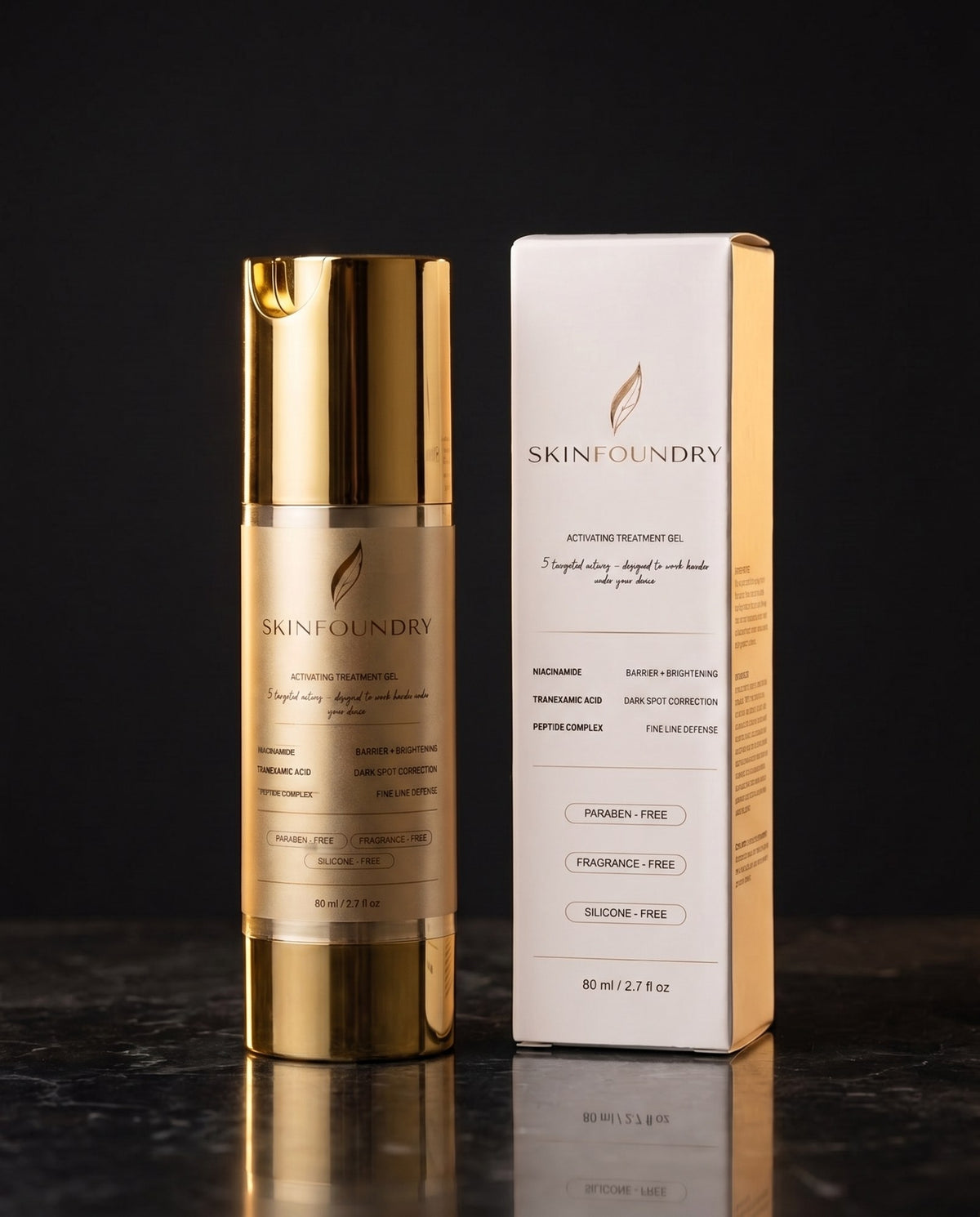
This is the reason SKINFOUNDRY built its treatment gel around device use. SKINFOUNDRY Lumis contains Acetyl Hexapeptide-8 at 0.5% alongside niacinamide 3%, tranexamic acid 2%, alpha-arbutin 1%, vitamin C and hyaluronic acid, in a water-based conductive gel. Used under SKINFOUNDRY Halo, the device’s Import mode (EMS with purple LED) is specifically designed to enhance absorption of the actives, so the peptide is delivered while the device works rather than left to sit on top. On off days, Lumis works as a hand-applied serum. How the technology and formula fit together is on Our Science. SKINFOUNDRY Halo is a cosmetic device for home use, and results vary.
Which peptide is best for wrinkles?
It depends on the wrinkle.
- Expression lines (crow’s feet, forehead, frown lines): Argireline, because they are caused by movement.
- Lines from collagen loss (cheeks, general crepiness): signal peptides such as Matrixyl (Palmitoyl Pentapeptide-4), which encourage a repair response.
- Slow healing, dullness, post-treatment skin: copper peptides.
Many good formulas combine two types. For a firming and lifting routine built around a device, the expression-line peptide is the natural fit, because the device handles the skin firmness layer with RF and the muscle layer with EMS.
How to use peptides
- Apply to clean skin before heavier creams and oils, which can block them.
- Use consistently. Peptides work by repeated signaling. Daily hand application, or two to three device sessions a week, both count.
- Pair freely. Peptides work alongside niacinamide, hyaluronic acid, vitamin C and retinoids. The one caution: apply retinoids and strong acids at a different time than a device session.
- Give it eight to twelve weeks. Expression lines soften gradually.
Can you use peptides with retinol?
Yes, and it is a good pairing. Retinol supports collagen and cell turnover; peptides signal repair and calm expression creasing. Use retinol at night, and if you are using a device, keep the retinol on a non-device night to avoid driving it in with warmth or current.
Frequently asked questions
How long do peptides take to work? Hydration and smoothing within a couple of weeks. Visible softening of expression lines in eight to twelve weeks of consistent use. Results vary.
What percentage of Argireline is effective? Studies and formulations typically range from 0.5% to 10%. Concentration matters less than consistency and delivery. A lower concentration delivered under a device can outperform a higher one applied by hand.
Are peptides safe for sensitive skin? Peptides are among the best-tolerated actives. Reactions are rare and usually come from other ingredients in the formula.
Do peptides help with sagging? Indirectly. Peptides help skin look smoother and support firmness. Sagging involves muscle and deeper structure, which is device or clinic territory. The strongest at-home approach is peptides delivered under RF and EMS.
Can peptides replace Botox? No. They can soften the look of expression lines gradually and gently. They cannot stop movement. Many people use peptides to extend time between injections or as a needle-free alternative with realistic expectations.
SKINFOUNDRY Halo is a cosmetic device for home use. It is not intended to diagnose, treat, cure or prevent any disease. Results vary. Botox is a registered trademark of its owner and is referenced for comparison only.