Yes, microcurrent works, for one specific thing: it contracts facial muscles, and repeated sessions leave the face looking more toned and lifted for a while. It does not tighten skin, does not build collagen in any documented way, and its visible effect fades within a day or two unless you keep using it. The published evidence is thin but consistent on that narrow claim. Whether it is worth the money depends on whether muscle tone is your actual problem, and for most people over 40 it is only half of it. Here is what the research shows, what the marketing leaves out, how microcurrent compares with EMS and radiofrequency, and how to decide.
What microcurrent does
Microcurrent devices deliver a very low electrical current, usually a few hundred microamps, through two contact points on the skin. The current is below the threshold most people can feel. In the face, it does two things that matter:
- It stimulates facial muscles. The muscles of the cheeks, jaw and brow respond to the current with tiny contractions. Repeated over weeks, this is the “workout for your face” that device brands describe.
- It moves fluid. The mild stimulation encourages lymphatic drainage, which is why faces look less puffy and more defined right after a session.
The immediate effect, a subtly lifted and de-puffed look, is real and shows up in the mirror within one session. It is also temporary. Most of it is gone by the next morning.
What the studies actually show
Microcurrent has a longer research history than most beauty technology because it started in medicine, for wound healing and for restoring facial muscle after Bell’s palsy. That is where the strongest evidence sits.
For cosmetic use, the studies are small, often funded by device makers, and measure things like “perceived lift” rather than anything structural. Read fairly, they show:
- Measurable short-term change in facial contour and muscle tone after a course of sessions, typically eight to twelve weeks of regular use.
- No documented change in collagen or skin thickness. Claims that microcurrent “rebuilds collagen” are not supported by the published work. The skin over the muscle is not the target of the current.
- Effects that require maintenance. Studies that follow participants after they stop find the improvement recedes over weeks.
The honest summary a dermatologist would give: microcurrent is safe, pleasant, and produces a modest, temporary toning effect in the muscles. It is not a skin treatment.
What microcurrent cannot do
| The claim | The reality |
|---|---|
| Tightens loose skin | No. Skin laxity is a collagen and elastin problem in the dermis. Current passes through it without changing it. |
| Builds collagen | Not documented. Radiofrequency and microneedling have that evidence; microcurrent does not. |
| Removes jowls | Partly. It tones the muscle under a jowl, which helps definition. The loose skin over it stays loose. |
| Permanent results | No. Muscle tone fades without use, like any workout. |
| Replaces Botox or filler | No. Different mechanisms entirely. |
| Works on the neck | Weakly. The platysma is a flat sheet muscle that responds less than the cheek muscles. |
Microcurrent vs EMS vs radiofrequency
People compare these three constantly, and they do different jobs.
| Microcurrent | EMS | Radiofrequency | |
|---|---|---|---|
| What it targets | Facial muscle (gently) | Facial muscle (firmly) | Skin, the dermis |
| Can you feel it | Usually not | Yes, a rhythmic pulse | Yes, warmth |
| Immediate effect | De-puffed, subtly lifted | Visibly toned | Plumped, warm glow |
| Effect that builds | Muscle tone over 8 to 12 weeks | Muscle tone, faster per session | The look of firmness over 4 to 12 weeks |
| Addresses skin laxity | No | No | Yes |
| Addresses muscle slack | Yes | Yes, more strongly | No |
| Best for | Puffiness, mild definition, maintenance | Jawline and cheek definition | Fine lines, crepey texture, firmness |
The reason this matters: a softening jawline is usually both problems at once. The muscle has lost tone and the skin over it has lost firmness. A microcurrent-only device addresses one. That is why so many people report that their NuFACE “worked at first, then stopped.” It did what it does, and the other half of the problem was untouched. The comparison is laid out in Microcurrent vs radiofrequency.
Does microcurrent work for jowls?
Half of the time. Jowls form when the cheek fat descends, the jaw muscles loosen and the skin over the jawline loses elasticity. Microcurrent tones the muscle, which sharpens the corner of the jaw somewhat. It does nothing for the skin, which is why results look better on people in their late 30s and 40s whose skin still has its elasticity, and less impressive on people in their 50s and 60s where the skin is the bigger factor. A fuller explanation is in What are jowls and what helps.
Do dermatologists recommend it?
Most are neutral to mildly positive. The typical view: harmless, modest, needs consistent use, and not a substitute for retinoids, sunscreen or professional treatments. Dermatologists tend to be warmer about at-home radiofrequency because the collagen response has been measured in clinical settings. The devices they dismiss are the ones that promise structural change from a few minutes of imperceptible current.
The negatives nobody mentions
- The gel is the cost. Microcurrent needs a conductive gel on every session. Brand gels run $30 to $60 a bottle and most are water, glycerin and a thickener. See What gel to use for microcurrent.
- The app dependence. Several devices lock treatment programs behind a phone app and subscription.
- The maintenance trap. Because effects fade, the device only pays off if it becomes a habit. Most abandoned devices are microcurrent wands in a drawer.
- The exclusions. Not for pregnancy, pacemakers or implanted electronics, epilepsy, active skin disease, or recently injected areas.
How to get the most out of microcurrent
- Use a proper conductive gel and enough of it. Dry skin means no current and no result.
- Work upward and outward, slowly. Hold each stroke for a few seconds at the end so the muscle contracts.
- Commit to eight weeks before judging. Take a photo in the same light on day one.
- Pair it with something that treats the skin. Retinoid, sunscreen, and ideally radiofrequency.
- Do not overuse it. Two to five sessions a week is plenty. More does not build faster.
Our view, and where SKINFOUNDRY Halo fits
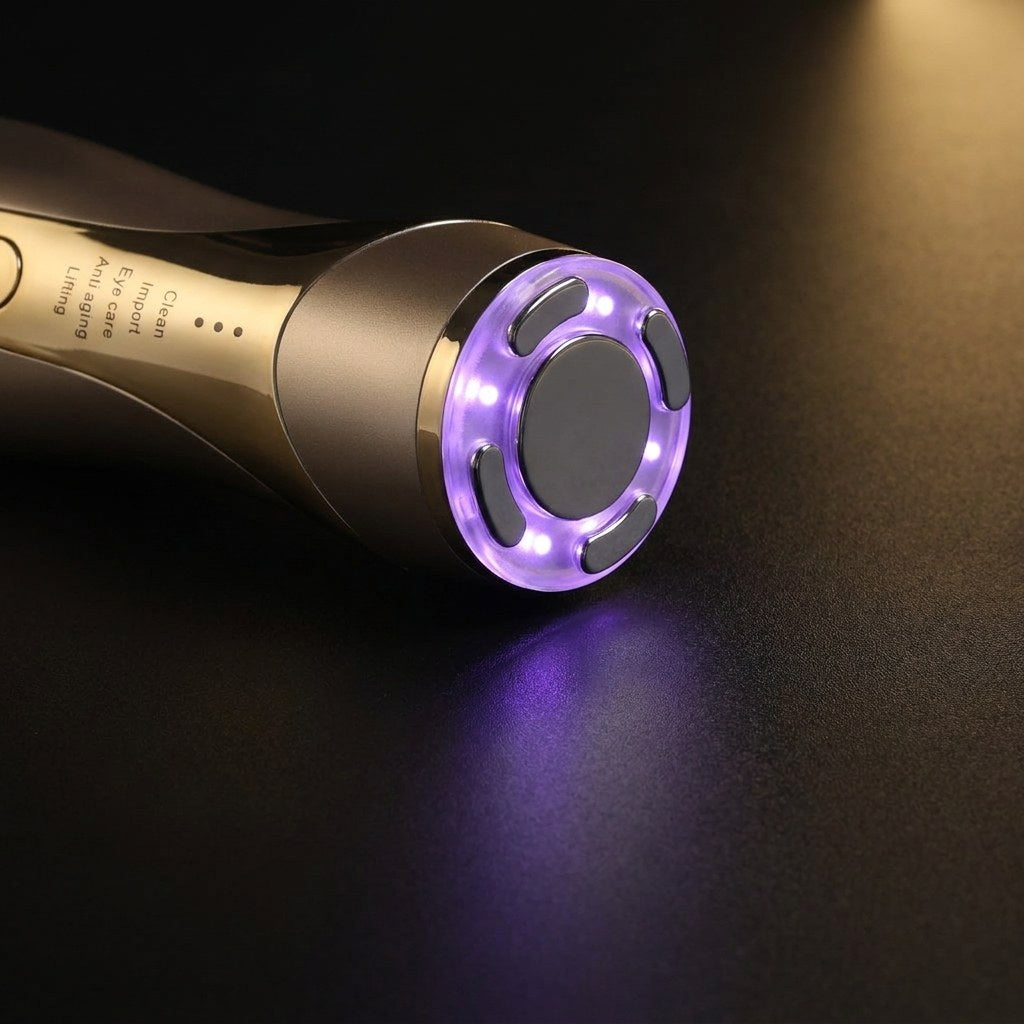
We include microcurrent in SKINFOUNDRY Halo because it earns its place, and we pair it with the technologies that cover what it misses. SKINFOUNDRY Halo runs five: bipolar radiofrequency (1 MHz, 7W maximum, capped at 40 degrees Celsius) for the look of firmer skin, EMS microcurrent for the muscles, ultrasonic in Clean mode, sonic vibration, and LED as a supporting component. Five timed modes, five minutes each, three intensity levels, no app. In Import mode the microcurrent pulses help drive SKINFOUNDRY Lumis actives deeper than hand application, so the gel session treats the skin instead of just conducting.
For a comparison with a microcurrent specialist, see SKINFOUNDRY Halo vs NuFACE. Halo combines RF and EMS with ultrasonic, sonic vibration and LED in one device. It is a cosmetic device for home use, and results vary.
Frequently asked questions
How long does microcurrent take to work? A de-puffed, subtly lifted look after the first session. Muscle tone that holds between sessions builds over eight to twelve weeks of consistent use. Results vary.
Is microcurrent a waste of money? Not if muscle tone and puffiness are your concerns and you will use it consistently. It is a waste if you expect it to tighten skin, or if the device ends up in a drawer after three weeks.
Is EMS better than microcurrent? EMS is stronger per session and you can feel it working, which many people find more motivating. Microcurrent is gentler and tolerated more often. Both target muscle, neither treats skin.
Can I use microcurrent every day? Low-level microcurrent is often used daily. EMS and radiofrequency are better at two to three sessions a week with rest days. See How often to use a facial device.
Does microcurrent work on the neck? Weakly, because the neck muscle is a thin sheet. Radiofrequency does more for the look of neck skin than current does for the muscle.
What happens when you stop? The toning effect fades over a few weeks, the same way muscle tone fades when you stop exercising. Nothing is lost beyond the improvement itself.
SKINFOUNDRY Halo is a cosmetic device for home use. It is not intended to diagnose, treat, cure or prevent any disease. Results vary. Competitor references are based on public product information at the time of writing.