After 50, the concerns that matter most are firmness, the jawline and neck, crepey texture, and uneven tone. The device technologies that address those are radiofrequency for the look of firmness, EMS or microcurrent for muscle lift, and a treatment gel that actually reaches the skin. A device that combines RF and EMS is the strongest single choice. LED-only tools and cleansing brushes are pleasant and do not address the main concerns. Here is what changes in skin after 50, what to look for, what to skip, and how to pick a device you will still be using in six months.
What changes in skin after 50
- Collagen and elastin keep declining, and for women the drop accelerates around menopause. Skin is thinner, drier and less elastic.
- The lower face softens. Fat pads descend, muscles lose tone and the jawline blurs into jowls. The neck shows laxity and bands.
- Texture becomes crepey, especially on the neck, chest and around the eyes, largely from dryness and collagen loss.
- Tone becomes uneven. Decades of sun show as spots and dullness.
- Skin is more reactive. Barrier function declines, so strong actives that were fine at 35 can sting at 55.
A device for this decade should address firmness and muscle, be gentle enough for a thinner barrier, and fit into a routine that is realistic to keep.
Do skin tightening devices actually work over 50?
Yes, with honest expectations. At-home RF and EMS improve how firm, smooth and lifted skin looks, and the change builds over four to twelve weeks of consistent use. On skin that has lost more collagen the change is more gradual, so consistency matters more, not less. What a device will not do at any age is reposition tissue the way surgery does. If a product promises that, it is overpromising.
Dermatologists generally see at-home devices as a useful maintenance layer, with RF better supported than microcurrent because the collagen response is better documented.
What to look for in a device after 50
- Radiofrequency. Non-negotiable if firmness is a concern. Look for real specifications (frequency, output, temperature cap) rather than “RF-like warmth.”
- EMS or microcurrent. For the jawline, cheeks and neck bands. EMS is stronger and more visible per session than microcurrent, which suits mature skin with more to address.
- A timed, guided routine. Modes that run themselves for a set time remove the guesswork and make the routine stick.
- A conductive treatment gel with actives. The device session is when actives get into the skin. A gel with peptides, niacinamide and hyaluronic acid does double duty.
- Intensity levels. Start low on a thinner barrier and build.
- A sensible schedule. Two to three sessions a week is sustainable. Daily is not, for most people.
What to skip
- LED-only masks and wands as a primary tool. Red light is a reasonable supporting component and does little on its own for laxity.
- Cleansing brushes. Fine for cleansing, irrelevant to firmness.
- Microcurrent-only devices if your main concern is skin laxity rather than muscle tone. They leave the skin untouched. See Microcurrent vs radiofrequency.
- At-home microneedling. Infection risk, inconsistent results, and unnecessary when RF is available.
- Anything under $60 claiming RF. Real RF output costs more than that to build.
Our pick, and why
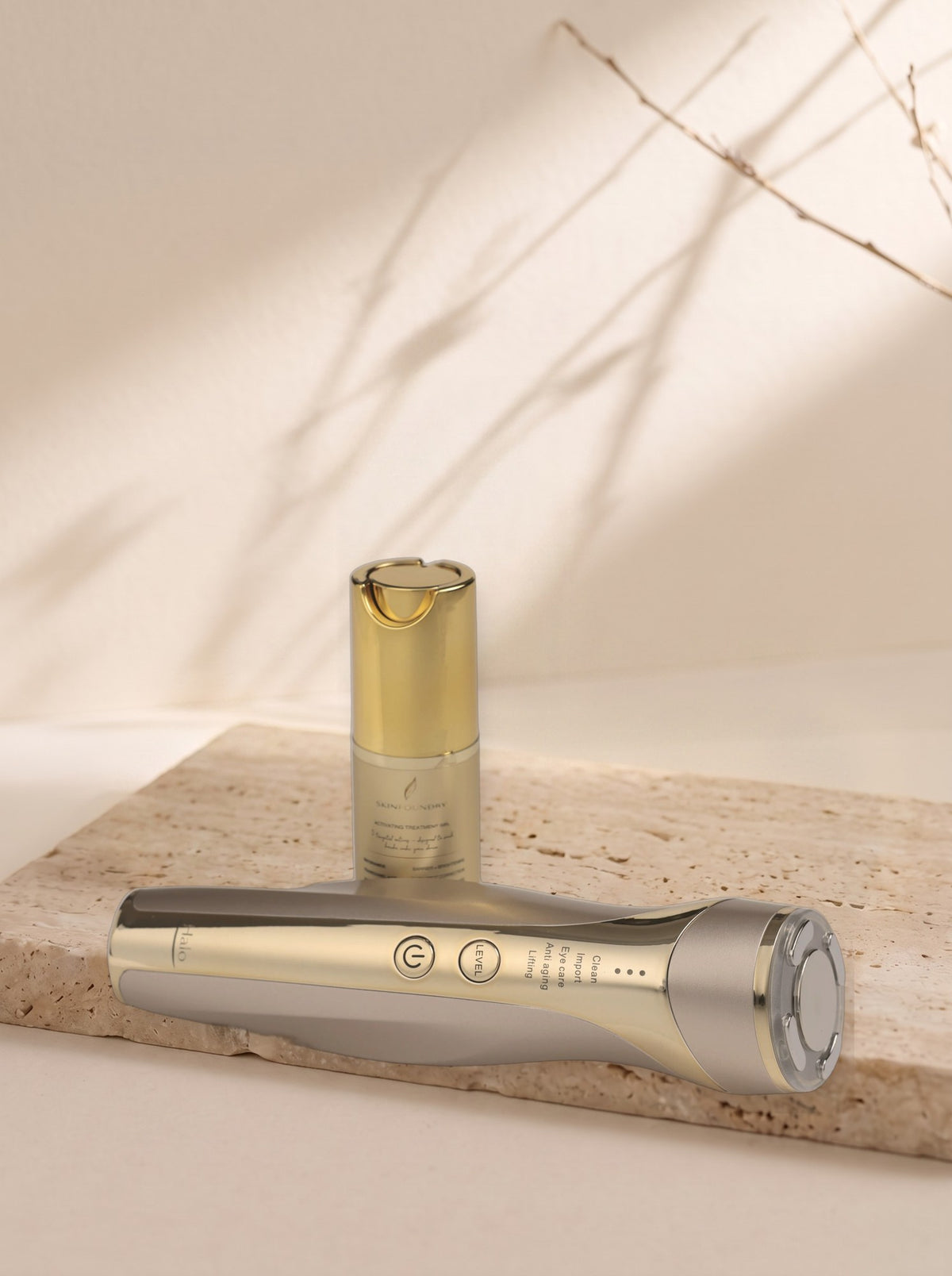
SKINFOUNDRY Halo was designed for exactly this decade. It combines bipolar RF (1MHz, 7W maximum, capped at 40 degrees Celsius), EMS for the muscles, ultrasonic and sonic vibration for cleansing and circulation, and LED as a supporting component, in one handheld device. Five timed modes run five minutes each with three intensity levels. The Essentials routine (Clean, Import, Lifting) takes fifteen minutes, two to three times a week.
It ships with SKINFOUNDRY Lumis, a treatment gel with niacinamide 3%, tranexamic acid 2%, a peptide complex, vitamin C, alpha-arbutin and hyaluronic acid, fragrance-free and formulated for reactive skin. The Import mode exists specifically to enhance absorption of those actives. For the tone concerns that arrive with this decade, tranexamic acid and alpha-arbutin address the look of dark spots while the device works on firmness.
Choose around your preferred routine and budget. See the comparison page for other treatment formats. SKINFOUNDRY Halo is a cosmetic device for home use, and results vary.
What is the best skin care routine for a 50-year-old woman?
Simple and consistent beats elaborate.
Morning: gentle cleanse, niacinamide and peptide treatment, moisturizer, sunscreen to the chest.
Device nights, two to three a week: cleanse, treatment gel, RF and EMS modes on jawline, cheeks, neck and around the eyes. Leave the gel on or moisturize after. No retinoid tonight.
Other nights: cleanse, retinoid (start low, twice a week, buffer with moisturizer), rich moisturizer.
Monthly: a photo in the same light to judge progress honestly. See Radiofrequency skin tightening at home for technique and timelines, and What are jowls and what helps for the jawline specifically.
Is it too late to start at 50, 60 or 70?
No. Skin at every age responds to hydration, protection and stimulation. The changes are more gradual on skin with less collagen, and they are visible. Someone starting at 60 should expect firmer, smoother, more hydrated-looking skin over three months rather than a lifted contour, and that is a meaningful change. The mistake is not starting late. It is starting and stopping after three weeks.
Frequently asked questions
Are at-home devices safe for thinner, mature skin? Yes, with gel, a moving device and the lowest effective intensity. RF warmth is gentle, and EMS intensity is adjustable. Avoid broken skin and follow the standard exclusions (pregnancy, implanted electronics, recent filler).
How long until I see results after 50? Hydration and smoothing within two weeks. The look of firmness builds over four to twelve weeks. Results vary.
Can I use a device if I have had filler or Botox? Generally yes once the treatment has settled, usually two weeks. Ask your provider, and avoid running RF directly over fresh filler.
Which is better after 50, a device or a clinic treatment? Different jobs. A clinic treatment is a bigger single change; a device is the maintenance that keeps skin looking its best between visits or on its own. Many people do both.
What about the hands and chest? Facial devices are designed for the face and neck. The chest can be treated carefully with the same technique. Hands are better served by sunscreen and retinoid.
SKINFOUNDRY Halo is a cosmetic device for home use. It is not intended to diagnose, treat, cure or prevent any disease. Results vary. Competitor references are based on public product information at the time of writing.